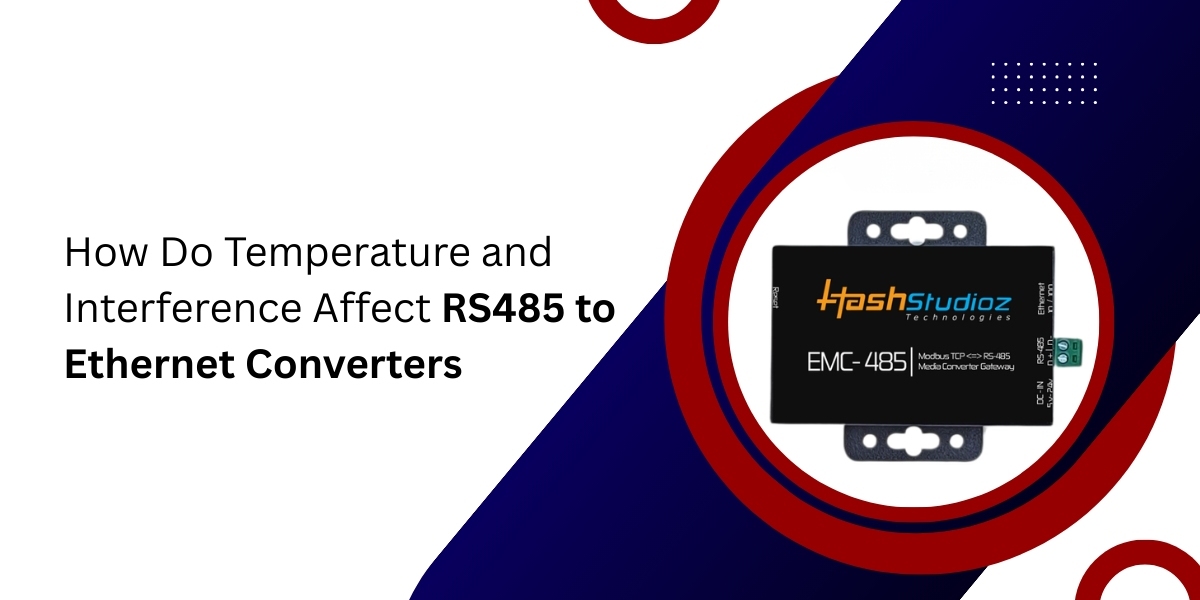

The RS485 to Ethernet Converter (also called an RS485 to LAN Converter) is widely used in industrial, automation, and monitoring systems. It connects devices on RS485 serial networks to Ethernet, enabling remote control and data collection. However, environmental factors such as temperature changes and electromagnetic interference (EMI) can significantly affect its performance. Understanding these factors is crucial for ensuring reliable operation.
Overview of RS485 Converters
RS485 is a differential serial communication standard designed for robust data transfer over long distances and in electrically noisy environments. The RS485 signal can travel up to 1200 meters and support multiple devices on the same bus.
A RS485 to Ethernet Converter takes serial RS485 signals and translates them into TCP/IP or UDP packets for Ethernet networks. This allows legacy industrial equipment to communicate over modern networks. These converters are essential in applications such as:
Industrial automation
Energy monitoring
Environmental sensing
Remote device control
The effectiveness of the converter depends not only on its design but also on environmental conditions.
The Impact of Temperature
Temperature has a direct effect on the electronics inside RS485 to LAN Converters. Components such as transceivers, crystals, and capacitors all behave differently depending on the temperature.
1. Effects on Electronics
Resistance Changes: Copper wiring in RS485 cables increases in resistance as temperature rises. This can reduce signal strength and cause communication errors in long networks.
Transistor Behavior: Semiconductor components change their threshold voltages and gains with temperature. High temperatures may increase error rates, while low temperatures may slow down response times.
Crystal Oscillator Drift: Converters rely on crystal oscillators for timing. Temperature changes can slightly shift oscillator frequency, leading to timing mismatches between RS485 and Ethernet signals.
Capacitor Variation: Capacitors in power supplies and filters are temperature-sensitive. Changes can affect voltage stability, sometimes causing converters to reset or malfunction.
2. Cable and Signal Effects
Temperature also affects RS485 cables:
At very low temperatures, increased capacitance can slow signal rise and fall times.
At high temperatures, cable insulation may degrade, leading to short circuits or increased signal reflections.
Example Scenario
In outdoor monitoring systems, daily temperature swings from −30 °C to +50 °C can cause moisture condensation inside converter housings. This can result in short circuits or corrosion, increasing the likelihood of data loss or device failure.
The Impact of Electromagnetic Interference
Even though RS485 uses differential signaling to reduce noise, strong EMI can still disrupt communication.
How EMI Affects Converters
Electromagnetic interference (EMI) can significantly impact the performance of converters, especially in systems using RS-485 communication. EMI introduces unwanted voltages and currents that can corrupt data signals, reduce reliability, and increase error rates. Key effects include:
1. Differential Noise: Differential noise occurs when strong electromagnetic fields induce voltages between the RS-485 lines. These voltages can be misinterpreted by the converter as valid data signals, leading to transmission errors, corrupted packets, and unreliable communication, particularly in electrically noisy industrial environments.
2. Common-Mode Noise: Common-mode noise arises when electromagnetic interference generates identical voltages on both RS-485 lines relative to ground. If the voltage exceeds the converter input’s tolerance, it can disrupt data interpretation, causing bit errors, packet loss, or temporary communication failures.
3. Ground Loops: Ground loops develop when connected devices or converters have different grounding potentials, creating stray currents along communication lines. These currents introduce additional noise, reduce signal integrity, increase packet loss, and can compromise overall system performance if grounding is not properly managed.
Real-World Example
In a factory setting near welding equipment, RS485 to Ethernet Converters without shielding experienced intermittent data loss. By installing shielded cables and proper grounding, error rates dropped by over 90%.
Combined Effects of Temperature and Interference
Temperature variations and electromagnetic interference (EMI) often interact, amplifying the challenges for reliable system operation. Their combined effects can degrade signal integrity, increase errors, and lead to system downtime if not properly mitigated. Key impacts include:
1. Signal Degradation from High Temperatures
High temperatures increase the resistance of communication lines and reduce signal amplitude. Lower amplitude signals are more vulnerable to EMI, making them easier to corrupt. This combination results in increased errors, unreliable data transmission, and reduced system performance.
2. Moisture and Insulation Loss
Temperature fluctuations can cause condensation and moisture buildup, lowering insulation resistance in cables and devices. Reduced insulation allows interference currents to flow more easily, making the system more susceptible to EMI-induced noise and increasing the likelihood of communication errors.
3. Increased Failures and Downtime
Systems exposed to both high temperatures and EMI without proper mitigation experience frequent communication failures, higher packet loss, and occasional device downtime. Proactive measures, such as shielding, cooling, and monitoring, are essential to maintain reliability and operational continuity.
Consequences of Environmental Stress
Environmental stress, including temperature fluctuations, electromagnetic interference (EMI), and moisture, can significantly impact system reliability. These stresses degrade signal integrity, disrupt communication, and increase operational costs. Key consequences include:
1. Data Errors
Bit errors caused by EMI, temperature drift, or moisture can corrupt data frames transmitted between devices. Corrupted data may result in inaccurate monitoring, control failures, or incorrect system responses, potentially affecting safety, efficiency, and overall operational performance.
2. System Downtime
Environmental stress can trigger communication failures that halt normal system operation. Equipment may require manual resets or intervention, increasing downtime and reducing overall productivity. Persistent issues may compromise reliability and disrupt automated processes critical to building or industrial systems.
3. Increased Maintenance Costs
Frequent errors and failures caused by environmental stress elevate labor, maintenance, and replacement costs. Additional resources are needed to troubleshoot, repair, or replace affected components, reducing system efficiency and increasing the total cost of ownership over time.
Mitigation Strategies
Proper design, installation, and component selection reduce temperature and EMI impacts on RS-485 converters, improving reliability, reducing errors, and minimizing maintenance requirements in harsh or noisy environments.
1. Temperature Mitigation
Use industrial-grade converters rated for –40 °C to +85 °C, install them in thermally protected enclosures, and apply conformal coating to prevent condensation, ensuring reliable operation in extreme temperatures and harsh industrial environments.
2. Interference Mitigation
Use shielded twisted-pair cables for RS485, ensure proper grounding and circuit isolation, route cables away from high-power lines, install termination resistors, and employ converters with EMI suppression or surge protection for reliable communication.
Conclusion
Temperature and electromagnetic interference are critical factors for RS485 to Ethernet Converters and RS485 to LAN Converters. Temperature affects electronic components and cable properties, while EMI introduces noise that can disrupt communication. Proper selection, installation, and protective measures ensure reliable operation, even in harsh industrial environments. By understanding these effects, engineers can maintain data integrity, reduce downtime, and extend the life of RS485 converter networks.