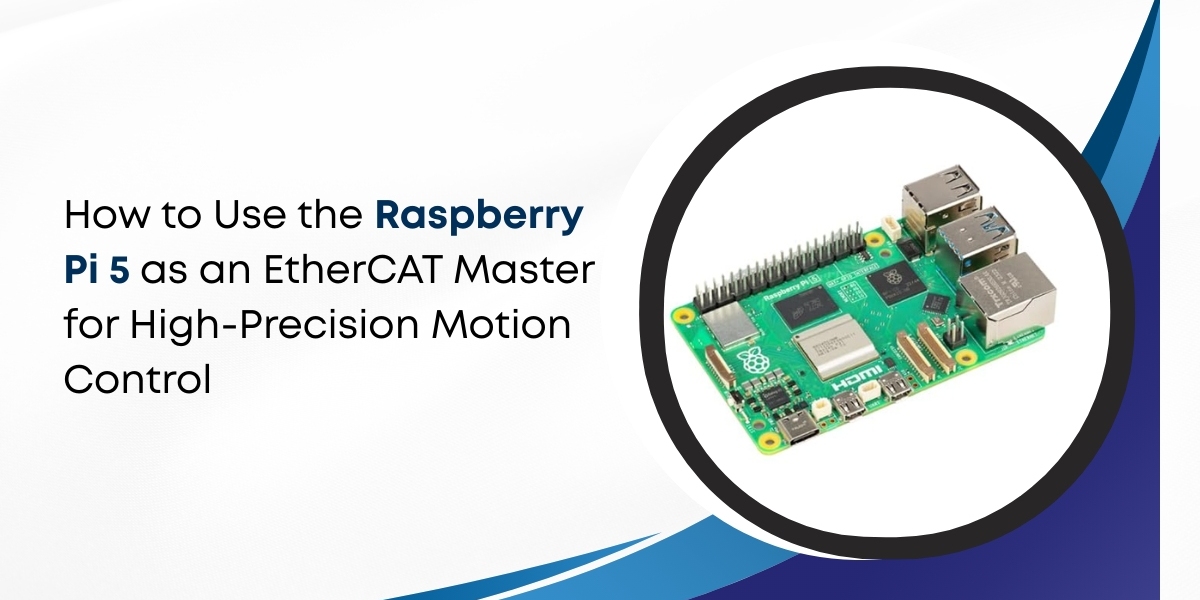

Modern industrial automation demands accurate, synchronized, and deterministic motion control. EtherCAT (Ethernet for Control Automation Technology) remains one of the most widely used real-time industrial Ethernet protocols for this purpose. Traditionally, engineers relied on industrial PCs or PLCs as EtherCAT masters. Today, the Raspberry Pi 5 provides enough processing power and network capability to serve as an EtherCAT master for many high-precision applications.
This article explains how to configure the Raspberry Pi 5 Model 8GB as an EtherCAT master. It covers hardware requirements, real-time Linux configuration, EtherCAT stack selection, performance tuning, distributed clocks, motion control integration, and practical deployment strategies. The perspective remains technical and implementation-focused throughout.
What Is EtherCAT?
EtherCAT is a deterministic Ethernet-based fieldbus protocol defined under IEC 61158. It achieves high performance through on-the-fly frame processing. Instead of receiving and retransmitting frames like traditional Ethernet nodes, EtherCAT slaves read and write data as the frame passes through them.
Key technical characteristics:
Cycle times down to 100 microseconds
Synchronization jitter typically under 1 microsecond
Support for hundreds of nodes in a single segment
Distributed clock mechanism for precise timing
These properties make EtherCAT ideal for servo control, robotics, CNC machines, and synchronized multi-axis systems.
Why Use Raspberry Pi 5 as an EtherCAT Master?
1. Hardware Improvements
The Raspberry Pi 5 features a quad-core ARM Cortex-A76 processor running at 2.4 GHz, up to 8 GB of RAM, a PCIe Gen 2 x1 interface, and a true Gigabit Ethernet controller. These upgrades improve I/O bandwidth and overall performance for industrial control tasks.
2. Enhanced Processing Performance
Benchmarks indicate the Raspberry Pi 5 delivers roughly twice the integer processing performance of the Raspberry Pi 4. This higher computational capability directly benefits real-time scheduling, EtherCAT cycle execution, and precise control loop operations in automation systems.
3. Low Hardware Cost and Compact Size
Raspberry Pi 5 combines powerful processing with a small footprint and low cost. This makes it ideal for laboratory automation, prototyping, and light industrial applications, where space and budget constraints require efficient yet capable hardware solutions.
4. Flexible Linux-Based Environment
The Raspberry Pi 5 runs a Linux-based operating system, offering a flexible and open development environment. Users can deploy custom software, real-time kernels, and EtherCAT master stacks, enabling tailored control strategies and seamless integration with analytics or visualization tools.
5. Large Developer Ecosystem
With a vast community of developers, libraries, and support resources, the Raspberry Pi 5 platform simplifies development and integration. This ecosystem accelerates prototyping, reduces troubleshooting time, and enables integration with cloud services or monitoring platforms for comprehensive automation solutions.
EtherCAT Master Requirements
An EtherCAT master must:
Generate deterministic cyclic traffic
Maintain strict timing accuracy
Support distributed clocks
Manage slave configuration states
Process control data within fixed deadlines
Motion control applications often require cycle times between 250 microseconds and 2 milliseconds. The master must compute control outputs before the next cycle begins.
Hardware Setup
To configure Raspberry Pi 5 as EtherCAT master, gather the following:
Raspberry Pi 5 Model 8GB
High-quality 32 GB or larger microSD card
Stable 5V 3A or higher power supply
Industrial-grade Ethernet cables (Cat5e or Cat6)
EtherCAT-compatible servo drives or I/O modules
The Raspberry Pi 5 onboard Ethernet works for most applications. In advanced systems, engineers sometimes dedicate one Ethernet interface exclusively for EtherCAT traffic.
Real-Time Linux Configuration
Standard Linux kernels do not guarantee deterministic timing. Motion control demands predictable scheduling. For this reason, use a PREEMPT_RT patched kernel.
1. Why PREEMPT_RT Matters
PREEMPT_RT reduces kernel scheduling latency. It converts many kernel operations into preemptible threads. This lowers jitter and improves task responsiveness.
Typical latency measurements on Raspberry Pi 5 with PREEMPT_RT:
Average latency: 20–30 microseconds
Worst-case latency under moderate load: below 80 microseconds
These values support millisecond-level motion control loops.
2. Key Configuration Steps
Install a Linux distribution compatible with PREEMPT_RT
Update the system to the latest kernel version
Verify real-time capability in kernel information
Disable unnecessary background services
Assign real-time priorities to motion control processes
Reducing background load helps maintain consistent cycle timing.
Selecting an EtherCAT Master Stack
Several EtherCAT master implementations support Linux platforms.
1. IgH EtherCAT Master
Runs at kernel level
Provides low jitter
Integrates well with PREEMPT_RT
Suitable for precise motion control
2. SOEM (Simple Open EtherCAT Master)
User-space library
Portable and lightweight
Easier integration for application developers
For demanding motion applications, IgH often provides lower jitter due to kernel-level integration. For research and education, SOEM offers flexibility and simplicity.
Network Configuration for EtherCAT
EtherCAT requires raw Ethernet frame access. The master communicates directly with slaves over Ethernet.
Important configuration considerations:
Dedicate one interface for EtherCAT
Avoid routing normal TCP/IP traffic over the same interface
Use direct cable connections or EtherCAT-compatible switches
Ensure correct cable termination
Improper cable quality can introduce communication errors that affect motion accuracy.
EtherCAT Slave Initialization
After installing the EtherCAT stack, perform the following steps:
Detect connected slaves.
Verify slave state transitions (INIT, PRE-OP, SAFE-OP, OP).
Load slave configuration files (ESI files).
Map process data objects (PDOs).
Activate operational state.
Each slave must enter Operational (OP) state before control loops begin.
Distributed Clocks for High Precision
Distributed clocks (DC) synchronize all EtherCAT slaves to a common time reference. This feature ensures consistent timing across drives and I/O modules.
Without distributed clocks:
Axes may drift over time
Phase offsets may appear
Position errors may accumulate
With distributed clocks enabled:
Clock drift stays below one microsecond
Multi-axis synchronization improves
Interpolation accuracy increases
Many modern servo drives rely on DC to maintain sub-millimeter motion accuracy.
Implementing the Motion Control Loop
A typical EtherCAT motion control loop performs these steps each cycle:
Receive process data from slaves
Read position and velocity feedback
Compute control algorithm (PID, feedforward, model-based control)
Write new position or torque commands
Send updated process data
Cycle times depend on application complexity. Common cycle times:
1 millisecond for general servo systems
500 microseconds for fast positioning
250 microseconds for high-speed robotics
The Raspberry Pi 5 Model 8GB can support 1 millisecond cycles reliably when properly configured.
Real-Time Optimization Techniques
1. CPU Isolation
Assign one CPU core exclusively to the motion control task. This reduces scheduling interference from other processes.
2. Real-Time Priority
Use high real-time priority for the control thread. This ensures predictable execution order.
3. Disable Power Saving
Disable CPU frequency scaling. Fixed frequency operation reduces timing variation.
4. Minimize Interrupt Load
Avoid heavy USB or background network traffic during control operation.
Applying these techniques improves worst-case latency and reduces jitter.
Performance Expectations
With optimized configuration, Raspberry Pi 5 can achieve:
Stable 1 millisecond cycle time
Jitter below 50 microseconds
Reliable communication with 10–50 EtherCAT slaves
In small systems, engineers report 99.9 percent communication stability during continuous 24-hour operation.
While this performance does not replace high-end industrial controllers in all scenarios, it satisfies many lab and mid-level automation needs.
Example Application: Two-Axis Servo Control
Consider a dual-axis positioning system:
Two EtherCAT servo drives
One digital input module
One digital output module
System setup:
Raspberry Pi 5 Model 8GB with PREEMPT_RT
IgH EtherCAT master
1 millisecond control cycle
Distributed clock enabled
Observed results:
Axis synchronization within 10 microseconds
Position repeatability within servo drive limits
No communication dropouts during 12-hour test
This setup demonstrates feasibility for robotics research and small automation cells.
Diagnostics and Monitoring
Effective monitoring improves reliability.
Monitor:
Slave states
Working counters
Cycle time consistency
Clock synchronization offset
Logging cycle times and jitter helps identify timing drift or overload conditions.
Safety Considerations
Motion systems must include safety mechanisms:
Hardware emergency stop circuits
Watchdog timers in EtherCAT drives
Fault state detection
Safe torque off (STO) features
Do not rely solely on software control for safety-critical systems.
Comparing Raspberry Pi 5 with Industrial Controllers
Feature | Raspberry Pi 5 | Industrial PLC |
Cost | Low | High |
Real-time control | Software configured | Hardware optimized |
Certifications | Limited | Extensive |
Flexibility | High | Moderate |
Expandability | Custom | Modular |
Industrial PLCs provide certified reliability and rugged enclosures. Raspberry Pi 5 offers flexibility and cost efficiency for controlled environments.
Statistics Supporting EtherCAT Adoption
Over 60 million EtherCAT nodes installed worldwide
EtherCAT remains one of the fastest-growing industrial Ethernet protocols
Deterministic Ethernet usage in automation increased by more than 40 percent in the last decade
These figures show strong industry trust in EtherCAT technology.
Practical Deployment Recommendations
To ensure success:
Use high-quality power supplies
Ensure adequate cooling for Raspberry Pi 5
Protect hardware in industrial enclosures
Test under full system load before deployment
Validate timing under worst-case CPU usage
Proper engineering practice improves long-term stability.
When to Use Raspberry Pi 5 as EtherCAT Master
Suitable applications include:
Robotics research
Laboratory automation
Educational training platforms
Small production cells
Prototype motion systems
For high-speed CNC or safety-critical heavy machinery, dedicated industrial controllers may remain preferable.
Conclusion
The Raspberry Pi 5, particularly the Raspberry Pi 5 Model 8GB, provides sufficient processing power and network capability to function as an EtherCAT master for many high-precision motion control applications. By combining real-time Linux, a reliable EtherCAT stack, distributed clocks, and optimized scheduling, engineers can achieve deterministic communication with low jitter.
With proper configuration and testing, Raspberry Pi 5 supports millisecond-level control cycles and synchronized multi-axis systems. It offers a cost-effective and flexible platform for research, education, and small-scale industrial automation.